





A needle-free vaccine delivery technology developed from AIBN research is helping reimagine vaccine delivery, allowing limited supplies to go further and simplifying storage and transport.
And it is a patch no bigger than a postage stamp.
“This technology is poised to have a significant humanitarian impact across the globe.”
Dr Dean Moss, CEO, UniQuest

A bold idea
In 2006, Professor Mark Kendall and his team at AIBN set out to develop an alternative to needle and syringe delivery of vaccines.
The hypodermic syringe has saved millions of lives since it was invented in 1853, but it has its limitations.
20 per cent of people have a fear of needles and 1.3 million deaths per year are caused by needle-stick injuries.
Through needles, vaccines are delivered to muscles, but the researchers sought a better response by directly targeting the abundant immune cells located immediately below the surface of the skin.
By 2011, UQ’s technology transfer company, UniQuest, had secured funding and established startup company Vaxxas Pty. Ltd. to develop the new high-density microarray patch (HD-MAP) technology.

What’s in a patch?
“It’s much more user-friendly than a needle – you simply ‘click’ an applicator on the skin, and 5000 microscopic projections almost-imperceptibly deliver vaccine into the skin. Associate Professor David Muller, UQ’s School of Chemistry and Molecular Biosciences, part of the UQ development team.
The HD-MAP technology is one-centimetre square with thousands of vaccine-coated micro projections.
The projections are coated with liquid drops of vaccine, which are then dried.
When applied to the skin via an applicator device for a few seconds, the vaccine is delivered to the immune cells beneath the skin.
Better immunity, better logistics
The researchers achieved their aim of producing a better immune response because vaccines delivered via HD-MAP induce immune responses similar to, or even stronger than, traditional intramuscular (IM) injections, often using a fraction of the dose.
This not only enhances efficacy but also reduces the overall cost of vaccination.
But the benefits don’t end there, the patch’s dry formulation significantly improves thermostability of the vaccine, enabling storage at temperatures up to 40°C without refrigeration.
By eliminating the need for ‘cold chain’’ storage, the technology reduces costs and simplifies transport and distribution.
This is particularly significant in low-resource settings where lack of refrigeration can be a major barrier to vaccination access.
Delivering vaccines in a pandemic
“HD-MAP technology is likely to play an important role in future pandemics because it allows vaccines to be quickly and easily deployed to people.”
David Hoey, President and CEO, Vaxxas (2012-2025)
The delivery of many vaccines, particularly to disadvantaged and hard-to-reach populations, remains a significant challenge.
Not only does HD-MAP bypass refrigerated storage and distribution, but the vaccines could also be self-administered using a simple user-friendly applicator.
Reducing reliance on trained healthcare professionals is especially valuable in pandemic scenarios, where quarantine, isolation, and workforce constraints can limit access to care.
By enabling rapid, scalable deployment, HD-MAP has the potential to strengthen global pandemic response efforts.

Solutions for society
Vaxxus remains closely connected with AIBN, now partnering with the mRNA BASE facility to accelerate the use of HD-MAP technology for mRNA vaccines.
While mRNA vaccines have proven highly effective in protecting against diseases such as COVID-19, their distribution depends on ultra-cold storage and administering by trained medical professionals.
This is a hurdle that HD-MAP technology can help mRNA vaccines jump over.
These are challenges that HD-MAP technology is well positioned to overcome.
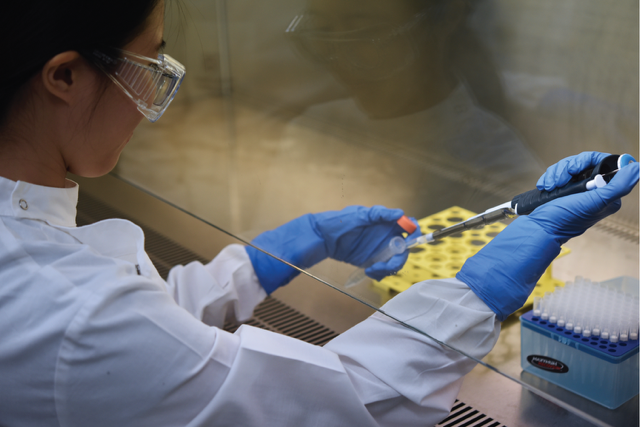
Patch-based mRNA vaccines for COVID-19, seasonal influenza, and pandemic influenza could optimise the delivery of many vaccines, particularly to disadvantaged populations.
“Vaxxas’ HD-MAP will make it possible to post vaccines directly to people in their homes.” David Hoey
Building on its roots at AIBN, Vaxxas is commercialising a bold technology.
This postage-stamp-sized patch is making vaccines more effective, accessible, equitable and ready for the challenges of today and tomorrow.

Join The Network
Stay on top of our industry news and developments, events and opportunities, by joining The Network
Sign up today