





What if plastic waste could help power a clean-energy future?
That's the challenge driving Dr Yunqing Kang, an expert in advanced nanomaterials whose ambitious vision is to use sunlight, seawater and discarded plastics to produce hydrogen fuel.
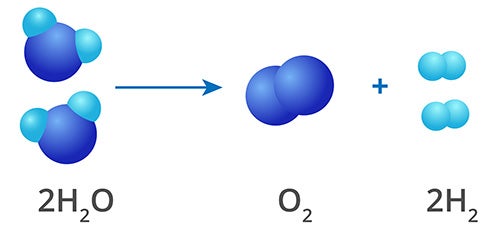
Hydrogen is seen as a clean fuel because it can be made by splitting water into hydrogen and oxygen using renewable electricity and produces no carbon emissions.

"Ultimately, I want to use sunlight to power a system that converts plastic waste and water into hydrogen and other valuable products."
Dr Kang’s research interests have consistently focused on designing and making nanomaterials with properties tailored for specific applications.
And now he is armed with an ARC Discovery Early Career Researcher Award (DECRA) to support his work designing the materials needed to bring his long-term vision to life.
Saving energy with plastic
Dr Kang explained that the main goal of his DECRA project is to use molecules derived from plastic waste to reduce the energy needed to produce hydrogen.
“During water splitting to make hydrogen, there are two chemical reactions. One produces hydrogen, while the other produces oxygen,” he said.
“Generating oxygen is the most energy-intensive part of the process.
“By combining the process with plastic molecules undergoing oxidation, the overall energy consumption for hydrogen production can be lowered.”
Making hydrogen from seawater
Producing hydrogen usually requires clean water and purifying that water adds cost.
“97 per cent of the world’s water is seawater, so it is abundant and cheap – perfect for making hydrogen more efficiently,” Dr Kang said.
“But the downside is that seawater contains high concentrations of salts and impurities – and the challenge is designing catalysts that are both active and stable in its harsh environment.”
Ideally, catalysts are substances that speed up chemical reactions without being consumed themselves or undergoing significant changes.
Current catalysts often rely on expensive precious metals, but Dr Kang is designing materials that are made from more abundant materials such as iron, nickel and cobalt.

Everything starts with materials
Less than a year into his project, Dr Kang has published two research papers that tackle different problems which he needs to solve to reach his goal.
One focuses on catalyst materials to make hydrogen production from seawater more efficient. The other explores how nanomaterials can be designed to detect and interact with hard-to-find plastic molecules.
"Everything starts with the materials. If you don't have the right material, you can't do anything."
Capable catalysts
Dr Kang has created a new manufacturing method for producing extremely thin, porous metal alloy coatings on a range of conductive surfaces.
These materials can be tailored for different purposes, including acting as catalysts in the simulated seawater splitting reaction.
These non-precious metal catalysts are highly efficient, low-cost, corrosion-resistant and designed to withstand the harsh environment of seawater.
“If hydrogen can be produced more efficiently and cheaply, it could support the transition away from fossil fuels as one part of the clean energy mix.”
While hydrogen is not a simple fix for the clean-energy transition, it remains a promising option for hard-to-electrify sectors – so it is critical that researchers like Dr Kang continue to tackle challenges around cost, efficiency and scale.

Join The Network
Stay on top of our industry news and developments, events and opportunities, by joining The Network
Sign up todayDetecting hard-to-find pollutants
But producing hydrogen from plastic waste will require more than efficient catalysts.
Dr Kang also needs to understand how nanomaterials recognise and interact with specific molecules, including plastic-derived compounds.
“For a sensor to work, the target molecule has to interact strongly with the material – this is the challenge.”
He has developed a new semiconductor nanomaterial that can detect tiny traces of hard-to-find pollutants in water, such as microplastics, allowing them to be detected in complex water samples.
This ultrasensitive detection method identifies chemicals by detecting their unique molecular "fingerprints".
“Some pollutants are very difficult to find because they occur at tiny concentrations and don't readily interact with existing detection technologies.
"This material makes those pollutants much easier to spot.”
This technology also has the potential for use in environmental monitoring and water safety.

Motivated by discovery
Dr Kang explains that to tackle any challenge, he first needs to understand how to design materials with very specific properties and interactions.
“Designing materials is the foundation of everything I do.”
He finds fulfilment in scientific discovery and problem-solving.
He values the process of identifying problems, designing strategies to address them and achieving breakthroughs.
“Whenever I find something interesting, something new, I feel genuinely happy.”

Scaling up for industry
Dr Kang acknowledges that while the advanced nanomaterials he develops are currently expensive and challenging to scale up for industry, one day it will be possible.
He aspires to develop small, scalable devices powered by solar energy to break down plastic and water simultaneously, to generate hydrogen and value-added chemicals.
“We all should have a goal. We should have a dream.”

Want to learn more about this story or how you can partner with AIBN on ground-breaking research?
Contact us via email: communications@aibn.uq.edu.au
or phone: +61 414 984 324


