





Congratulations to AIBN’s Associate Professor Seth Cheetham, a leading researcher in targeted therapeutics and biomanufacturing, on his appointment as director of the National Biologics Facility (NBF).
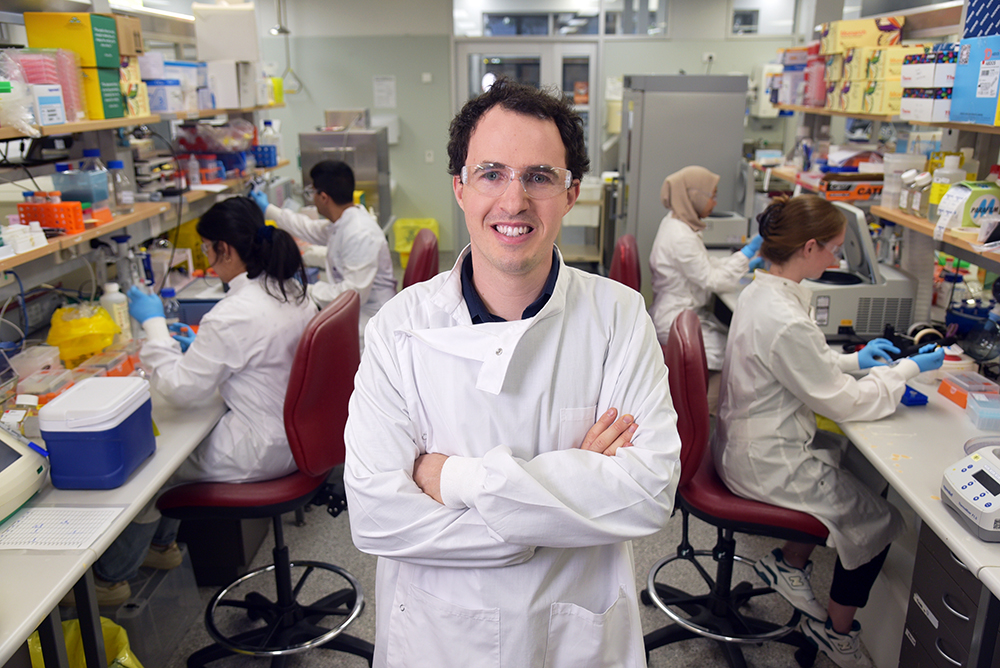
“In the next decade, many breakthrough medicines won't come from Big Pharma's labs – they'll come from university researchers and small biotech companies,” Dr Cheetham said.
“My role at NBF is to make sure that Australian discoveries can bridge the ‘valley of death’ and reach the clinic.”
“Housed at AIBN, we have both world-class expertise and capabilities to develop and manufacture biologics, translating discoveries into new medicines including cancer drugs, immunotherapies and vaccines.”
“Researchers or companies come to us with an idea for a therapeutic and we turn that idea into reality.”
7 of 10 best-selling drugs are biologics
Biologics are drugs that are based on proteins and peptides – anything that is an amino-acid chain.
Out of the 10 best-selling drugs in the world, seven of them are biologics.
Five of these are monoclonal antibodies for treating cancer and autoimmune conditions, and two are peptides marketed as weight loss drugs. Ozempic is one of them.

“Monoclonal antibodies make great therapeutics because they are very stable in the body – we can mimic these immune cell molecules that our body produces naturally, redesigning them to target disease,” Dr Cheetham said.
Crossing the ‘valley of death’
The ‘valley of death’ describes the gap between discovery-stage research and clinical development, where many promising therapies fail due to lack of funding, data, manufacturing capability or industry confidence.
“The NBF exists to bridge this gap by providing the manufacturing expertise, quality data, and clinical-grade materials that researchers and companies need to attract investment and progress their pipelines.”
“They come to us with early-stage discoveries and leave with validated, tested materials ready for human trials.”
NBF also gives researchers the opportunity to work in an environment similar to commercial biomanufacturing, which is a unique experience within Australia.
Successes so far
Since its establishment in 2008, NBF has enabled six clinical trials.
These include UQ’s Molecular Clamp Technology, which was recently acquired by Sanofi for 1.15 billion USD, an antibody that protects against the deadly Hendra virus, and a radiopharmaceutical that can detect the spread of ovarian and bladder cancer.
“When you're developing a new vaccine or a new therapeutic, the more data and quality you can get behind it, the more valuable it becomes.”
“At NBF, we can help researchers evaluate in human trials whether their experimental vaccines or therapies are going to work, which is a unique capability within Australia,” Dr Cheetham said.
Expert staff and facilities
“Our team of over 18 expert staff has extensive experience working with researchers to advance new medicines, many with experience from the commercial biomanufacturing sector – I’m very fortunate to lead such an excellent team.”

“At AIBN, we’re also home to advanced imaging capabilities where we can further characterise a biologic.”
“We’re also connected to other national capabilities, for example BASE mRNA Facility, where we can draw on their mRNA expertise.”
“This easy access to complementary technologies and expertise is a distinct advantage and accelerates translation to the clinic.”
Join The Network
Stay on top of our industry news and developments, events and opportunities, by joining The Network
Dual role brings insight
Dr Cheetham continues his own research programme in targeted therapeutics alongside his work at NBF.
His dual role as both NBF director and active researcher gives him unique insight into the challenges facing academics seeking to translate discoveries.
“My own research started out very much in the fundamental understanding of disease, but around the time of the pandemic, I got really excited about the potential of emerging technologies like mRNA and targeted biologics.”
“My team’s research sits at the intersection of protein and mRNA therapeutics.”
“We're using proteins to target mRNA to specific cells – our main focus is cancer, and we aim to develop drugs that can hit cancer cells whilst avoiding harm to healthy tissues.”
Shaping the future
 “It’s an honour to take on the leadership of NBF in a time of great transformation, including the advent of AI-enabled drug discovery.”
“This role brings together everything I care about: discovery, translation, and getting new medicines into the clinic.”
NBF is enabled by NCRIS and supported by The University of Queensland and Therapeutic Innovation Australia
Want to learn more about this story or how you can partner with AIBN on ground-breaking research?
Contact us via email: communications@aibn.uq.edu.au
or phone: +61 414 984 324


